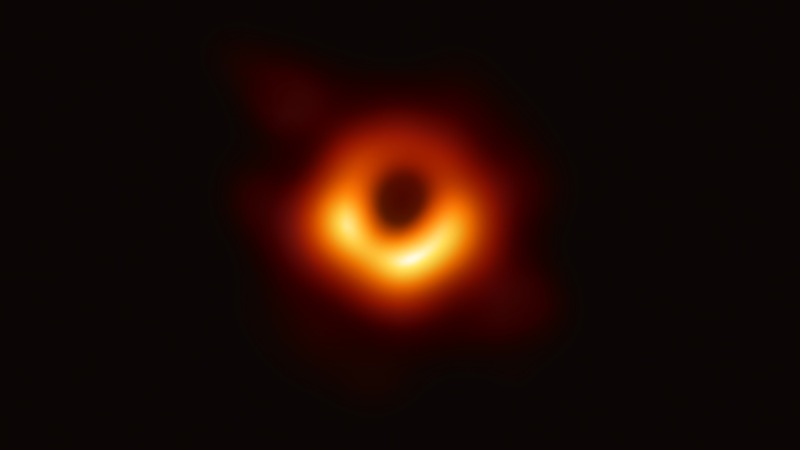
Photographing a Black Hole
Last Wednesday, a very important development for science was announced. For the first time, scientists captured a photograph of a real black hole and shared it with us at a press conference.
This black hole sits about 55 million light-years from Earth, right at the center of the galaxy known as “Messier 87” near the Virgo galaxy cluster, and it is also 6.5 billion times more massive than the Sun.
But beyond how fascinating the black hole itself is, the methodology that made photographing it possible is just as impressive. According to the scientists, capturing a photo of such a massive black hole at that distance would require a telescope the size of Earth. Since that isn’t possible, a project called the EHT—the “Event Horizon Telescope”—was launched. With the EHT project, images from giant telescopes placed at eight different points around the world were combined virtually, and using atomic clocks, the EHT team recorded the radio waves they captured from the black hole as data with what they themselves called unprecedented precision. The data were so large (5 petabytes) that uploading them over the internet wasn’t feasible, so they were saved on hard drives and sent to the supercomputers at headquarters. Processing that data took even longer than expected even on supercomputers, and the release of the photograph had to be postponed until April 10, 2019.
This enormous black hole that was photographed was named Powehi, which means “a deep, ornate dark formation.”
Whenever I see the photo of Katie Bouman—who led the development of the algorithm that made the image possible—taken at the moment the photograph was processed, I feel an intense sense of happiness for someone else, and I’m proud.
Katie Bouman also played a role in creating the black hole simulated in the Interstellar film we all know—the one NASA described as “the closest to reality among black hole simulations carried out so far”—using “Computational Imaging” and “Einstein” equations. Today, by taking a major part in photographing a real black hole, she has written her name in history in golden letters.
You can watch the TEDx talk she gave about a year ago in the video below and hear her own explanation of the project I’ve tried to summarize above.
You can also find more details via this link on the EHT organization’s own site.
.png)
“Katie Bouman, who led the development of the algorithm that made photographing the black hole possible, and the moment the image was processed by the computers!”
Watching with disbelief as the first black hole image I helped create comes into being
- Katie Bouman